NICE AUTOMATION
NICE WIDE S Parking Gate Barrier UAE
NICE WIDE S Parking Gate Barrier UAE – 3 Metre Boom Kit The NICE WIDE S is a compact vehicle-access..
Price on Inquiry

Compare available models and open a product for its specifications and compatibility details.
NICE WIDE S Parking Gate Barrier UAE – 3 Metre Boom Kit The NICE WIDE S is a compact vehicle-access..
NICE WIDE M Parking Gate Barrier UAE – 4 Metre Boom Kit The NICE WIDE M is a 4 metre automatic boom..
NICE WIDE L Parking Gate Barrier UAE – 5 Metre Boom Kit The NICE WIDE L is a 5 metre parking barrie..
NICE parking gate barriers control vehicle entry and exit at residential compounds, office car parks, hotels, commercial buildings and managed industrial premises. An automatic boom barrier creates a visible stopping point across a vehicle lane, then raises its arm after an authorised opening command. The right system combines the barrier operator, an appropriately sized boom, access controls and safety detection matched to the entrance.
Explore NICE WIDE S, WIDE M and WIDE L parking barriers for projects in Dubai, Sharjah, Abu Dhabi and throughout the UAE. This category brings together the 3 metre, 4 metre and 5 metre kits currently listed on NICE Gate Opener UAE. Compare the equipment by opening width, traffic intensity, operating speed and installation requirements rather than choosing from arm length alone.
The WIDE S kit is a compact starting point for private parking lanes, smaller residential entrances and controlled staff car parks. The listed configuration includes a 3 metre boom, a 24V DC drive and integrated controls. Its minimum opening time is 4 seconds, with a maximum operating frequency of 100 cycles per hour at nominal torque. This makes the operating pattern an important selection factor: a quiet private entrance and a shared lane with concentrated arrival traffic can place very different demands on the same barrier.
The WIDE S cabinet measures 280 × 178 × 1000 mm and has a listed barrier weight of 40 kg. Confirm the equipment island, maintenance access and usable lane width before installation. The 3 metre kit designation describes this package; alternative arm configurations require checking against the exact operator and approved accessories.
View NICE WIDE S specifications and kit detailsThe WIDE M kit provides a 4 metre boom and is worth considering where the entrance needs a higher nominal cycle frequency. Its minimum opening time is 3.5 seconds and its maximum rating is 300 cycles per hour at nominal torque. Typical projects include office parking, residential communities and managed commercial entrances, provided the complete system is suitable for the actual site. Faster opening can help traffic movement, but authorisation checks, vehicle spacing and the closing sequence also determine the rate at which cars pass.
The WIDE M has a 140 Nm rated torque, 300 W maximum power consumption and a cabinet measuring 320 × 205 × 1000 mm. Check peak-hour demand, boom clearance, detection coverage and the intended access-control interface when comparing it with a smaller operator.
View NICE WIDE M specifications and kit detailsThe WIDE L kit serves entrances needing the listed 5 metre boom configuration. It is relevant to wider parking approaches at residential communities, commercial developments, warehouses and other managed premises. The model has a minimum opening time of 5 seconds, 200 Nm rated torque and a maximum operating frequency of 200 cycles per hour at nominal torque. The wider span needs sufficient swept space and the correct balancing and mounting arrangement.
The cabinet measures 420 × 205 × 1030 mm, with a listed barrier weight of 54 kg and maximum power consumption of 360 W. WIDE L should be selected for the entrance geometry and required operating duty; it does not have a higher cycle rating than WIDE M simply because its arm is longer.
View NICE WIDE L specifications and kit details| Specification | WIDE S | WIDE M | WIDE L |
|---|---|---|---|
| Listed kit arm length | 3 m | 4 m | 5 m |
| Minimum opening time | 4 seconds | 3.5 seconds | 5 seconds |
| Maximum cycles/hour at nominal torque | 100 | 300 | 200 |
| Rated torque | 100 Nm | 140 Nm | 200 Nm |
| Maximum power consumption | 300 W | 300 W | 360 W |
| Motor drive | 24V DC | 24V DC | 24V DC |
| Standard mains version | 220–230V AC | 220–230V AC | 220–230V AC |
| Protection rating | IP54 | IP54 | IP54 |
Opening times are minimum movement ratings, not complete vehicle passage times. Hourly cycle figures apply under the manufacturer’s specified conditions. Arm accessories, operating settings, interruptions and environmental conditions must be considered during selection and commissioning.
Measure the clear vehicle opening and identify where the cabinet and any arm support can be installed. Allow space for the arm to travel without striking walls, overhead services, parked vehicles or landscaping. Assess the approach speed, driver visibility, queuing distance and whether vehicles enter and exit through the same lane.
Estimate the busiest operating period as well as daily traffic. A residential building with a concentrated morning rush may require a different duty rating from a private villa with occasional movements. Decide whether drivers will use remotes, cards, a security guard, intercom approval or number-plate recognition. These choices determine the controller interfaces, cabling and supporting equipment.
For replacement projects, photograph the existing operator label, control-board code, boom and installed accessories. Mechanical dimensions, wiring and radio compatibility can differ between generations. A new operator should be assessed as part of the complete installation rather than treated as a universal replacement.
A complete system may need photocells, vehicle loop detectors, radio receivers, remote controls, key selectors, warning lights, arm supports, batteries and suitable access-control interfaces. Each accessory performs a separate job: the receiver accepts a radio command, the control unit manages the operating sequence, and detection equipment provides information about the lane.
Match sensors and replacement electronics to the exact board. NICE BlueBUS devices and conventional contact-output photocells use different interfaces and should not be assumed interchangeable. When requesting a replacement control board, identify the printed PCB reference and operator revision. Browse our NICE spare parts and remote controls for model-specific enquiries.
We handle enquiries for NICE parking automation in Dubai, Sharjah, Abu Dhabi, Ajman, Ras Al Khaimah, Umm Al Quwain, Fujairah and Al Ain. Share the site location, entrance measurements and intended use to discuss an appropriate barrier package. Confirm delivery, installation, commissioning and maintenance scope in the quotation.
An opening command is received from a local button or a compatible access controller. The barrier control unit operates the motor and balanced boom mechanism, raising the arm to allow an authorised vehicle through. Depending on the configured operating mode, closing may follow a separate command, a programmed delay or an appropriately designed control sequence.
The sequence should account for vehicles waiting beneath or beyond the arm. Correctly positioned safety and presence devices help the controller respond to site conditions, but their function depends on wiring, settings and testing. Good traffic management also requires clear markings and a pedestrian route separate from the vehicle lane.
Plan for impact, trapping and unexpected movement around the boom, cabinet and surrounding structures. Photocells, suitable vehicle detection, visible indications and controlled approach speeds may all form part of the installation. A parking boom provides access management; it should not be described as a crash-rated security barrier.
Commissioning includes checking the foundation and fixings, balancing the selected arm, setting the operating sequence and testing command inputs, detection devices and manual release. The installer should demonstrate normal operation and the agreed power-failure procedure to the people responsible for the car park.
Assess direct sunlight, ambient temperature, sand, wind, drainage and coastal exposure at the installation location. The listed WIDE models have IP54 protection, which does not mean they are floodproof or suitable for pressure washing. Keep cable entries and seals correctly installed, and avoid locations where water collects around the cabinet.
A maintenance plan should cover boom condition, balancing, mounting security, cabinet seals, sensor cleanliness, manual release and any backup batteries. Repeated stops, abnormal noise or unreliable detection should be investigated rather than compensated for by raising force settings. Provide the model and board references when requesting service parts.
The current WIDE listings use price-on-enquiry so the required arm, cabinet version, controls and installation scope can be confirmed. Compare quotations using the complete equipment list: a barrier-only offer and a kit with detection, access controls, foundations and commissioning are not equivalent.
Include removal of existing equipment, electrical works, trenching, loop cutting, mounting foundations and any traffic-management requirements in the enquiry where applicable. Confirm warranty terms and ongoing support separately. Send entrance photographs and measurements through the contact or WhatsApp options on this page for a project-specific response.
Start with the clear opening, peak-hour vehicle movements and preferred access method. The listed WIDE S kit has a 3 metre arm, WIDE M a 4 metre arm and WIDE L a 5 metre arm. Match the installation to the operator rating, available space and required safety devices before choosing.
The kits differ in arm length, cabinet size, torque and operating-frequency rating. WIDE S is the compact option at 100 cycles/hour, WIDE M is rated at 300 cycles/hour, and WIDE L at 200 cycles/hour under the manufacturer’s stated conditions. A longer arm does not automatically provide a higher traffic capacity.
Not necessarily. The WIDE specifications shown here combine a 24V DC motor with a standard 220–230V AC mains input. Motor voltage and incoming supply voltage describe different parts of the system. Check the exact equipment label and electrical requirements.
It can form part of a compatible access-control installation using suitable command interfaces. Remote receivers, card readers, number-plate recognition cameras and their controllers are separate equipment unless explicitly included in the quotation. Compatibility must be checked against the installed control board.
No. Photocells detect an interruption across an optical beam; an inductive vehicle loop detects a suitable vehicle over a wired sensing area. Their coverage and functions differ, and the layout may require more than one type of detection. Neither should be treated as a substitute for a complete safety assessment.
The operator has a manual-release arrangement for authorised use according to its instructions. Compatible optional backup equipment, such as the specified PS324 accessory, may allow powered operations during an outage. Backup duration depends on the battery condition, configuration and operating demand.
A vehicle boom barrier should not be used as the pedestrian access route. Provide a separate pedestrian path and assess impact and trapping risks around the boom, cabinet and surrounding structures. A normal parking barrier is also not a crash-rated anti-ram barrier.
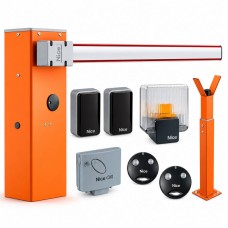
The three listed WIDE kits include the barrier, the stated boom length, a photocell pair, push button and fixing plate in the reference package. Confirm the final packing list and sensor compatibility before ordering. Remotes, receiver, loop detector, battery backup, lighting and installation are separate unless listed in the order.
Check the entire raised-arm clearance, ceiling height, pipework and lane layout. A standard straight arm may not suit a low ceiling. Any jointed-arm configuration must be approved for the exact model; do not assume that every WIDE operator accepts the same accessories.
Share the project location, entrance photographs, clear opening, overhead clearance, peak vehicle movements, available power and preferred entry method. State whether the requirement includes removal of an old barrier, foundations, cabling, loop installation, commissioning or maintenance.