
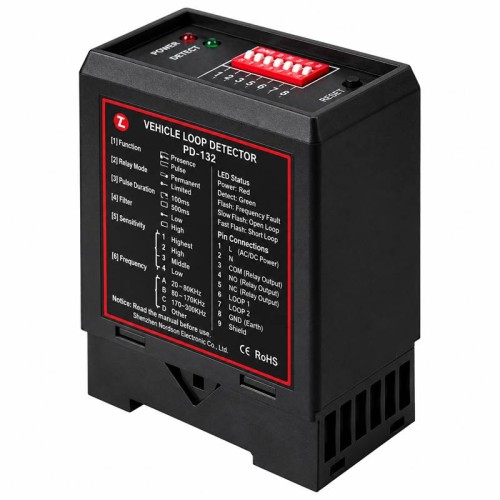
PD-132 230V Vehicle Loop Detector for Gate Barrier UAE
PD-132 230V Vehicle Loop Detector for Gate Barrier UAE
Vehicle Presence Detection for Gates and Parking Barriers
The PD-132 is a single-channel inductive detector used with a roadway sensing loop. This listing covers the 230 V AC version. The detector monitors a change in loop inductance when a vehicle occupies the detection area and provides a relay signal to a compatible gate, barrier or access-control system. It is an accessory module rather than a complete barrier controller.
PD-132 is a model designation used by different suppliers. This product is not presented as a genuine NICE detector or a Nortech PD132. Confirm the supplied unit’s label, voltage and wiring diagram before installation, especially when replacing a similar-looking module.
Features Explained
Single-channel operation: One channel monitors one sensing loop. Separate entry and exit zones need an appropriate multi-channel design or additional modules. Decide the required detection areas from the lane layout rather than combining independent zones without a control design.
Four sensitivity levels: Commission the detector for the vehicles using the entrance. Excessive sensitivity can respond to nearby metal movement; insufficient sensitivity can miss the intended vehicle. Test representative traffic at different positions in the zone.
Relay control output: The connected controller decides whether detection requests opening, holds the barrier open or performs another approved function. The detector should normally provide a control signal, not directly switch the gate motor’s power.
Selectable operating frequency: The listed frequency range is approximately 20–170 kHz. Adjacent loops require suitable spacing and settings. Commission neighbouring detection areas together so unwanted interaction is found before the entrance returns to service.
Technical Specifications
| Model | PD-132, 230 V AC version |
|---|---|
| Channels | One |
| Supply tolerance | +10% / −15% |
| Power consumption | Approximately 4.5 VA |
| Response time | Approximately 10 ms |
| Sensitivity | Four levels |
| Frequency | 20–170 kHz |
| Loop inductance | 50–1000 µH; recommended 100–300 µH |
| Relay rating | Up to 240 V AC / 5 A |
| Operating temperature | −20°C to +65°C |
| Housing dimensions | Approximately 78 × 40 × 108 mm |
| Lead cable | Up to approximately 20 m; minimum 20 twists per metre |
Detection Zone Planning
Start with the action required at the entrance. An approach loop can request opening, a presence loop can monitor the boom area, and a free-exit loop can detect departing traffic. Draw the vehicle path and identify where a stationary vehicle must remain detected. These functions may need different positions and controller settings.
Loop geometry, cable turns and installation depth must follow the exact detector instructions and site design. Consider reinforcing steel, drainage covers, motor wiring and neighbouring loops before cutting the road. A convenient existing road joint is not necessarily the correct location for a reliable detection zone.
Installation and Commissioning
A qualified installer must match the supply voltage and terminal diagram. Separate 12 V and 24 V variants must not receive 230 V. House this module in a suitable protected control cabinet with appropriate cable routing, ventilation and electrical protection. Outdoor use of a vehicle loop does not make the bare detector weatherproof.
Configure the relay contact and controller input together. Test vehicle arrival, departure, a prolonged stop and loss of supply. A limited-presence setting may behave differently from permanent presence when a vehicle waits beneath the barrier. Select the mode according to the intended control and safety design.
The detector does not identify authorised drivers, number plates or pedestrians. Access permission requires the relevant reader or access system. Retain required photocells, safety edges and other protection, and test the complete system after installation. A loop connection alone does not establish an effective anti-crush system.
Kit Includes
One PD-132 230 V detector module. Confirm socket/base availability in the quotation. Loop wire, roadway cutting, sealing materials, enclosure and installation are separate unless expressly included.
Applications in UAE Properties
Suitable projects include compatible car-park barriers, warehouse exits, vehicle presence at readers and properly designed bollard systems. Discuss the intended traffic flow with the site operator. A free-exit arrangement and a restricted-entry arrangement have different access requirements even when the same detector type is used.
Maintenance and Troubleshooting
If the detector reports an occupied loop while the lane is clear, investigate its settings, loop condition and surrounding metalwork. Intermittent detection can require checks of cable integrity, moisture entry, supply stability and nearby electrical interference. Keep a record of the commissioned settings for future service visits.
If the relay changes but the gate responds incorrectly, inspect the controller input and assigned function. Changing normally-open and normally-closed wiring without understanding the design may create a different fault. Retest with vehicles and the entrance supervised after any repair.
Why Choose PD-132?
This is a compact option for monitoring a single vehicle loop where the voltage and control interface suit the installation. Reliable results depend on correct loop construction and commissioning as much as the module itself.
Supply and Installation Enquiries UAE
Contact NICE Gate Opener UAE with your barrier model, controller photograph, supply voltage, lane layout and installation location. Ask whether the quotation covers detector supply, loop cable, road cutting, sealing and programming. Enquiries can cover Dubai, Sharjah, Abu Dhabi and other UAE locations.
Frequently Asked Questions
Is this the 24 V detector?
No. This listing is for 230 V AC; verify the physical label before connection.
Can it monitor two independent loops?
It has one sensing channel. Use a suitable design with additional channels for separate zones.
Can it work with a NICE barrier?
It may connect to a compatible control input. Check the exact board diagram and intended function.
Can I leave the detector outdoors?
Install the module inside a suitable protected cabinet rather than exposing it directly to weather.
Does detection automatically grant access?
No. Vehicle presence and permission to enter are separate functions.
Will it prevent closing onto a vehicle?
Only if the complete controller and detector arrangement is correctly designed, configured and tested for that behaviour.
Why Choose Us?
Discuss the required lane behaviour as well as the detector model before ordering. This helps define the correct voltage, accessories and commissioning scope for your entrance.